


 English
 中文简体
中文简体 Español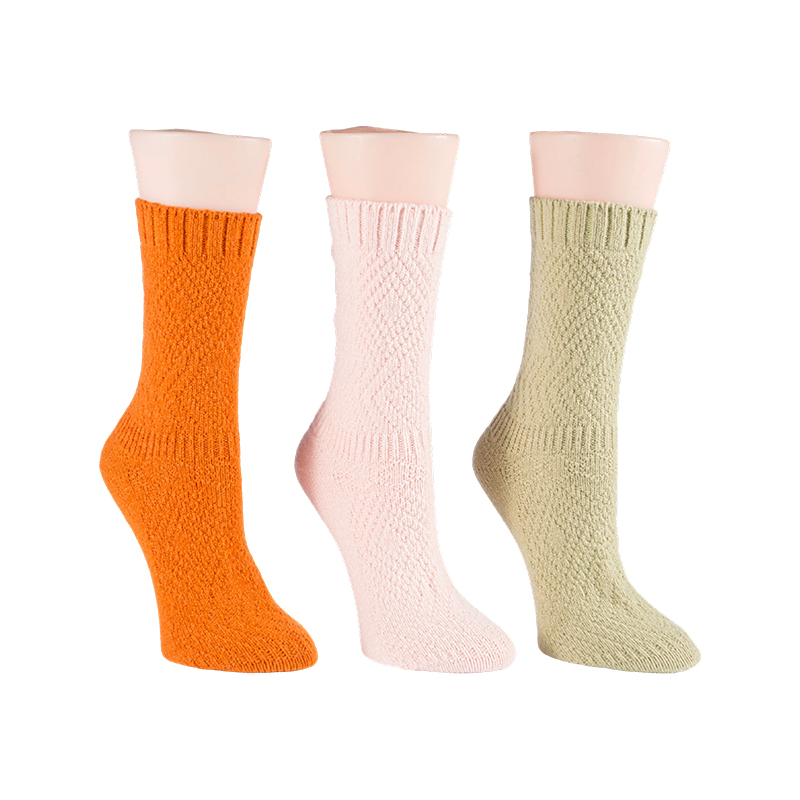
Product Information
These ladies' socks are constructed using a polyester fleece knit structure. The fabric surface undergoes a napping or raising process to create a fine layer of pile, altering the contact interface between fibers and skin. The material composition consists of 99% Polyester and 1% Spandex. Polyester serves as the primary structural component, providing fabric strength and dimensional stability. The inclusion of Spandex imparts circumferential stretch capability to the cuff and footbed, accommodating variations in foot girth. The product is designed for daily wear, utilizing the physical coverage of the fleece layer to provide basic foot warmth and contact cushioning.
Core Advantages
Contact Interface Optimization: The fleece layer on the fabric surface increases the number of contact points between fibers and skin, reducing pressure per unit area and minimizing localized compression. The directional arrangement of the pile maintains the sliding friction coefficient within a specific range, resulting in lower skin displacement resistance during wear.
Heat and Moisture Balance: Polyester fibers have a standard moisture regain of 0.4% and do not absorb liquid water. Perspiration secreted by the feet is transported as vapor through the interstitial spaces between fibers, preventing the formation of a liquid water film on the inner fabric surface and maintaining relative dryness of the skin.
Structural Integrity: The 84N DC gauge configuration results in a high loop density per unit area. The increased number of loops limits yarn slippage during stress, reducing the probability of laddering or unraveling during wear.
Product Specifications
Size Range: 9-11, fitting foot lengths of 22.5 to 25.5 centimeters and covering standard female foot widths.
Knitting Parameters: 84N DC gauge configuration, utilizing single-feed double-sided knitting technology to ensure uniform front and back fabric structure and consistent pile distribution.
Material Composition: 99% Polyester, 1% Spandex.
Pile Morphology: The fabric surface undergoes a raising treatment, resulting in pile lengths of 0.5-1.5 millimeters, with uniform density and no significant clustering or sparse areas.
Elastic Modulus: The Spandex component enables longitudinal stretch rates of 20-30% and transverse stretch rates of 30-40%, with a recovery rate exceeding 85% after force release.
Application Scenarios
Daily Commuting: Suitable for wear with leather shoes, sneakers, and other conventional footwear, providing a cushioning layer between the foot and shoe lining to reduce direct friction.
Light Outdoor Activities: Designed for use during spring and autumn activities such as walking or shopping, utilizing Polyester's quick-drying properties to manage humidity changes in the foot micro-environment.
Office Environment Suitability: Pairs well with professional attire and casual pants. The fleece structure results in low noise when contacting shoe insoles, making it appropriate for quiet office settings.
Common Issues & Handling Recommendations
Q: How should the stiffening of the fleece after washing be addressed?
A: Hard water may cause calcium and magnesium ions to adhere to fiber surfaces. Washing with softened water or adding a small amount of citric acid for neutralization is recommended. Hand rubbing after drying can help restore fluffiness to the fleece.
Q: What causes red marks on the ankle after wearing?
A: Circumferential pressure provided by the Spandex in the cuff, if exceeding lower limb venous return capacity, may lead to localized capillary dilation. Choosing a looser cuff size or reducing continuous wear time are potential solutions.
Q: Is foot discoloration after wearing black socks normal?
A: During initial wear of dark-colored fabrics, if feet perspire heavily, salts in sweat may extract unfixed dye molecules. Soaking in cold water with salt before first wear is recommended to fix color and reduce dye transfer probability.
Precautions
Detergent Selection: While Polyester has good alkaline tolerance, strongly alkaline environments may damage the spandex molecular structure. Using neutral detergents with pH values maintained between 6 and 8 is recommended.
Drying Method: Avoid using metal clips directly on the cuff during line drying to prevent localized stress concentration that could lead to Spandex fatigue and breakage.
Storage Environment: During long-term storage, avoid direct contact with volatile substances such as mothballs, as some naphthalene-based compounds may accelerate Polyester aging.
Component
99%Polyester
1%Elastane