Crafting Comfort, Defining Freedom

Latest Updates
Compression Socks Industry knowledge
Compression socks work through a principle called graduated compression — pressure is highest at the ankle and decreases progressively up the leg. This gradient is not arbitrary: it works with the cardiovascular system rather than against it, assisting the venous valves in the lower leg that must push blood upward against gravity back toward the heart.
Compression levels are measured in millimeters of mercury (mmHg) and are typically categorized as follows:
For most everyday and occupational use cases, the 15–20 mmHg range delivers meaningful circulatory benefit without requiring a medical prescription. Consistent daily wear in this range has been associated with measurable reductions in lower-leg swelling and end-of-day fatigue in occupational studies involving nurses, retail workers, and flight crews — populations who spend the majority of their working hours on their feet.
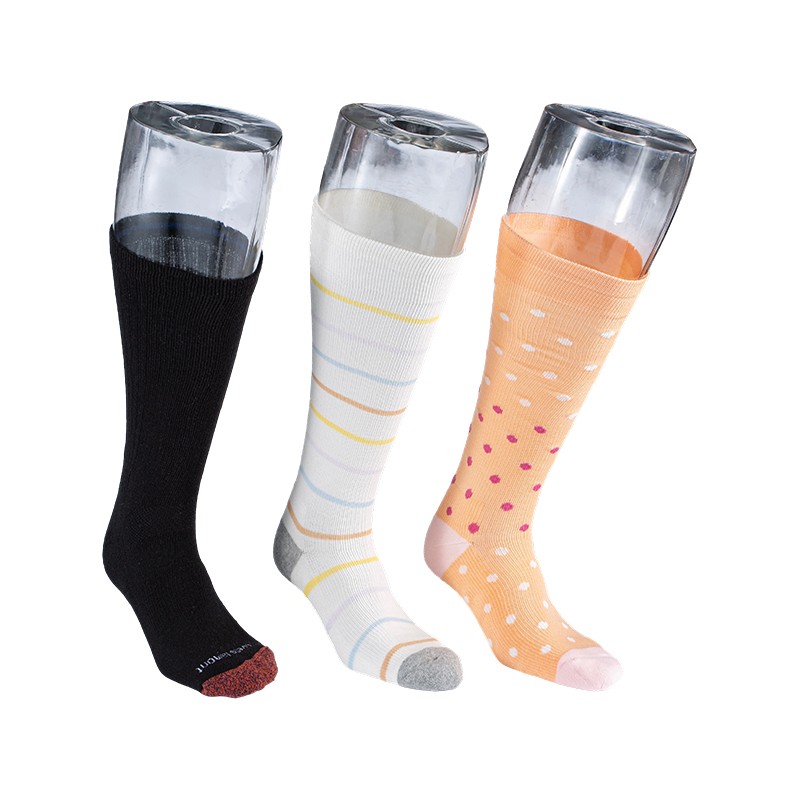
At Bonroy, compression architecture is designed with these physiological gradients as a foundation, ensuring that each Compression Dress Sock delivers pressure profiles that are functionally calibrated, not just structurally present.
The toe closure is the most structurally complex point in sock construction and the most common site of comfort failure. Conventional linked toe closures create a raised seam across the dorsal surface of the toe box — a ridge that, under the sustained pressure of a dress shoe worn for eight or more hours, becomes a significant source of irritation, blistering, and localized pressure points, particularly for wearers with bunions, hammer toes, or sensitive skin.
Seamless toe construction eliminates this seam through one of two methods: hand-linking, which joins the toe opening stitch-by-stitch on a specialized frame to produce a flat, low-profile closure; or true seamless knitting, in which the toe is closed during the knitting process itself without any secondary joining operation. The latter represents a higher level of engineering precision and produces a smoother interior surface across the entire foot profile.
In the context of compression socks worn inside dress shoes — where the shoe's structured upper creates an enclosed, pressure-concentrated environment — seamless construction is not a luxury specification. It is a functional requirement for all-day wearability. Seamless Compression Socks allow the compression mechanism to function as intended without introducing secondary discomfort at the one anatomical point where fit tolerances are tightest.
The longstanding tension in compression sock design has been between clinical function and professional appearance. Early compression hosiery was engineered purely for therapeutic outcomes — thick, opaque, and visually incompatible with business dress codes. The category has undergone significant design evolution, and modern compression dress socks are now constructed to pass as conventional dress hosiery while retaining meaningful compression performance.
Several construction techniques make this reconciliation possible:
The result is a garment category where circulatory benefit and dress-code compliance are no longer in conflict — a shift that reflects broader changes in how professional men approach the relationship between performance and appearance in daily wear.
| Feature | Standard Dress Sock | Compression Dress Sock |
|---|---|---|
| Pressure gradient | None | Graduated (ankle to calf) |
| Toe construction | Linked (raised seam) | Seamless or hand-linked |
| Swelling reduction | None | Clinically supported |
| Suitable for long travel | Limited | Yes |
| Visual profile | Dress-appropriate | Dress-appropriate (modern constructions) |
Compression dress socks are most impactful for people whose daily routines involve sustained static postures — standing at counters, sitting through back-to-back meetings, or traveling across time zones. The common thread is prolonged inactivity of the calf muscle pump: without regular contraction of the calf muscles, venous return slows and fluid accumulates in the lower legs by day's end.
Specific populations who consistently report the greatest benefit include:
Building a consistent wear habit is straightforward: put compression socks on in the morning before prolonged standing or sitting begins, as they are most effective when worn before fluid begins to pool. Donning them after hours of standing offers reduced benefit. Wash after each wear to maintain elasticity and hygiene — and as Bonroy approaches every detail of garment care, the materials used are selected to retain compression performance across repeated washing cycles without progressive degradation.




 English
 中文简体
中文简体 Español