

 English
 中文简体
中文简体 Español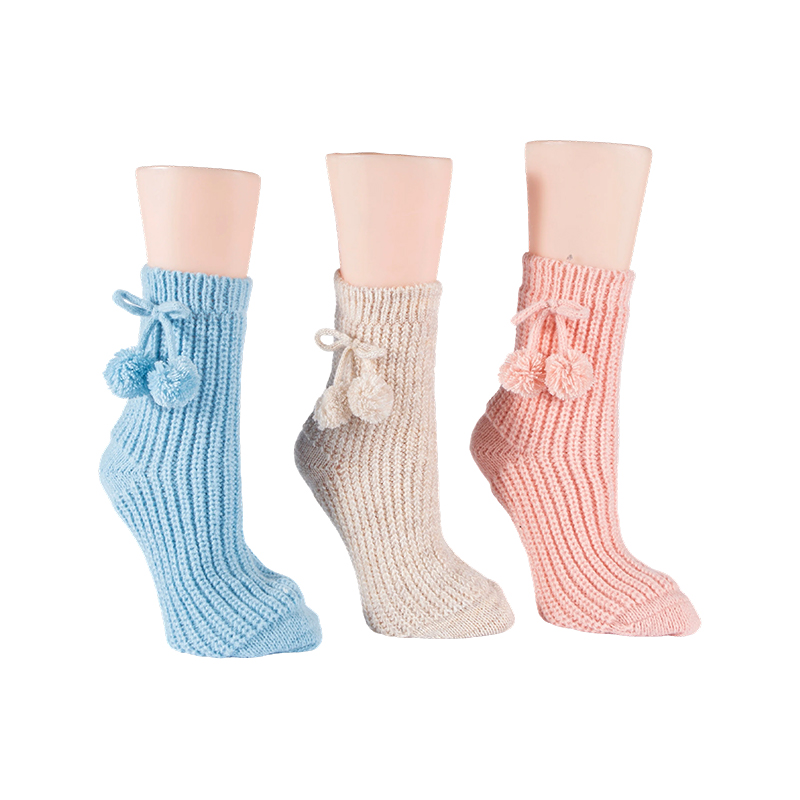
Product Information
These ladies' socks are manufactured using a 56N DC gauge configuration. This specific gauge parameter results in a relatively loose loop structure, with lower yarn density per unit area and correspondingly reduced fabric weight. The material composition consists of 99% Polyester and 1% Spandex. Polyester serves as the primary structural component, with a glass transition temperature of approximately 70-80°C, restricting molecular chain segment movement at room temperature and providing dimensional stability. The alternating hard and soft segment structure of Spandex enables reversible stretch performance in the cuff, returning to the original circumference upon force release. The product is positioned for daily lightweight wear scenarios, utilizing the loose fabric structure to achieve foot ventilation and basic coverage.
Core Advantages
Enhanced Air Permeability: The 56N DC gauge configuration creates larger inter-yarn spaces within the fabric, resulting in higher air transmission rates compared to denser fabrics. Warm, moist air generated by foot metabolism can rapidly diffuse through these spaces, reducing moisture accumulation in the micro-environment.
Reduced Compression Modulus: Lower loop density decreases overall fabric stiffness, increasing deformation under unit tensile force. Circumferential pressure distribution on the foot during wear is relatively uniform, minimizing localized pressure sensations.
Controlled Heat Capacity: Fabric weight decreases with lower gauge numbers, correspondingly reducing heat capacity per unit mass. Less heat is absorbed when transferred from the foot to the fabric, enhancing perceived coolness and suitability for warmer environments.
Product Specifications
Size Range: 9-11, fitting foot lengths of 22.5 to 25.5 centimeters.
Knitting Parameters: 56N DC gauge configuration, utilizing single-feed knitting technology with longer loop lengths, resulting in enhanced fabric softness.
Material Composition: 99% Polyester, 1% Spandex.
Fabric Density: Compared to the 84N configuration, the 56N fabric has approximately 30% fewer loops per unit area, with increased void ratio and correspondingly improved breathability.
Stretch Performance: The Spandex component enables longitudinal stretch rates of 25-35% and transverse stretch rates of 35-45%, with a recovery rate exceeding 80% after force release.
Application Scenarios
Spring and Summer Wear: Suitable for higher temperature environments, where the loose fabric structure facilitates air circulation and reduces foot stuffiness.
Office Environment: Designed for wear with leather shoes and low-cut footwear, with breathability sufficient for micro-environment needs during prolonged sedentary periods.
Light Activity Scenarios: Suitable for low-intensity activities such as yoga and walking, where fabric elasticity conforms to foot deformation with minimal movement resistance.
Common Issues & Handling Recommendations
Q: Are 56N gauge socks more prone to deformation?
A: Reduced loop density does lower initial fabric modulus. However, Polyester's high glass transition temperature limits molecular chain segment movement at room temperature, maintaining dimensional stability during daily wear. Avoiding high-temperature washing to prevent molecular chain relaxation is recommended.
Q: Does improved breathability mean reduced warmth retention?
A: Fabric thermal resistance correlates with thickness and void ratio. The 56N configuration increases void ratio, reducing still air entrapment capability and correspondingly lowering thermal resistance. This represents a physical balance between breathability and warmth retention.
Q: Why does elastic feel different with the same Spandex content?
A: Increased loop length provides greater yarn mobility within the fabric. With identical Spandex content, lower-density fabrics exhibit greater tensile deformation and a more pronounced elastic feel.
Precautions
Washing Temperature Control: Polyester molecular chain segment movement accelerates in water exceeding 60°C (140°F), potentially causing dimensional changes. Maintaining water temperature below 30°C (86°F) is recommended.
Mechanical Protection: Lower-density fabrics have weaker inter-loop binding forces. Using a laundry bag during washing is recommended to reduce entanglement with other garments.
Drying Method: Avoid prolonged direct sunlight exposure during line drying, as ultraviolet radiation may trigger photo-oxidation reactions in Polyester, leading to strength degradation.
Wear Pairing: Prolonged friction with rough shoe linings may cause yarn fraying. Pairing with smooth-lined footwear is recommended.
Component
99%Polyester
1%Elastane