

 English
 中文简体
中文简体 Español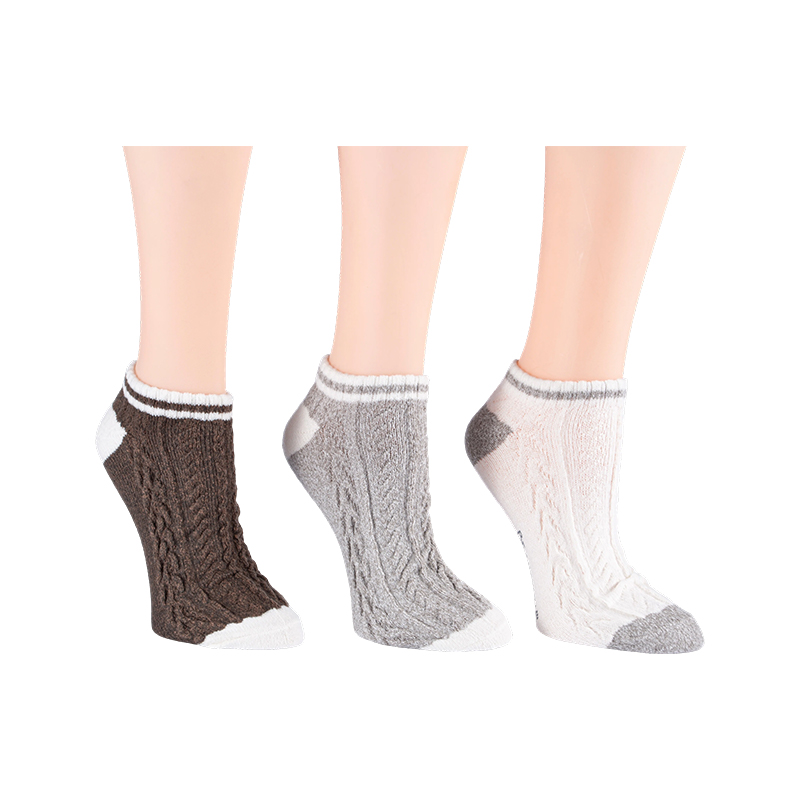
Product Information
Ladies SO SOFT LOW-CUT SOCKS employ 108N gauge knitting construction with cylinder density of 108 needles per inch. Fabric comprises 99% polyester and 1% spandex—polyester provides dimensional stability and abrasion resistance, while minimal spandex content delivers basic elastic recovery. Size 9-11 covers foot length 23-25cm range. Low-cut design positions the cuff below the shoe opening line, adapting to loafers, athletic shoes, and other low-profile footwear. 108N fine knitting forms a smooth fabric surface, reducing in-shoe friction resistance.
Core Advantages
Dimensional Stability: 99% polyester content controls washing dimensional change within 1% (GB/T 8628-2013), maintaining cuff and heel position stability through repeated wear. Polyester fiber heat-setting temperature 180-220°C completes shape memory during production; normal wear recovers smoothness when hung.
Abrasion Durability: Polyester tenacity 5.5-6.0cN/dtex combined with 108N fine-gauge interlock structure withstands 5000+ friction cycles at toe and heel without rupture. This characteristic adapts to high-frequency wear and machine washing environments.
Rapid Drying: Polyester's moisture regain 0.4% enables drying time of approximately 1.5-2 hours after standard washing, 60% shorter than cotton fabrics. This property supports daily wash-to-wear turnover requirements.
In-Shoe Compatibility: Low-cut design positions cuff below ankle bone, eliminating visible sock line when worn with low-profile shoes. 108N fine-gauge fabric thickness 0.3-0.4mm minimizes interior space occupation, reducing instep compression.
Technical Specifications
Gauge: 108N single cylinder circular machine
Fiber Composition: 99% Polyester / 1% Spandex
Size Range: 9-11 (foot length 23-25cm)
Fabric Thickness: 0.3-0.4mm
Fabric Mass: 25-35g/m²
Cuff Height: Low-cut (2-3cm below ankle bone)
Cuff Structure: Single-layer rib, 2cm width, pressure 2.0-2.5kPa
Heel Design: Contoured heel pocket
Toe Closure: Linked toe, seam thickness ≤0.5mm
Anti-Slip Treatment: Optional silicone strip or dot coating at heel interior
Application Scenarios
Daily Commute: Low-cut design conceals within low-profile styles, including loafers and oxfords, maintaining the shoe opening line integrity. Quick-dry properties support evening washing with next-morning wear.
Athletic Casual: Low-thickness structure adapts to athletic shoe cavity space, reducing fabric bunching between the instep and the tongue. Polyester abrasion resistance addresses in-shoe friction during walking and low-intensity activity.
Travel Packing: Fabric compresses and folds, occupying minimal luggage space. Quick-dry properties support a 2-hour air-dry time in hotel environments, reducing the quantity carried.
Warm Seasons: 0.3-0.4mm thickness and polyester with low moisture regain reduces foot heat accumulation above 25°C ambient temperature, maintaining relatively dry conditions.
Care & Maintenance
Wash at temperatures not exceeding 40°C, using neutral detergent pH 6-8. Polyester acid resistance exceeds alkali resistance; strong alkaline detergents cause fiber surface hydrolysis and strength loss.
Use a laundry bag to reduce friction between the heel anti-slip coating and the washing machine interior. Separate dark and light colors to prevent dye transfer in wet conditions.
Avoid direct sunlight when drying—prolonged UV exposure initiates polyester photo-oxidation, fiber embrittlement, and stiff hand feel. Clip at cuff when hang-drying, avoiding direct clamp contact with the toe seam area.
Ironing is generally unnecessary; polyester maintains a stable form after heat-setting. If ironing is required, the temperature should not exceed 150°C, avoiding direct contact with spandex elastic zones. High temperatures cause minimal spandex component thermal aging and reduced elastic recovery.
Store folded flat; avoid long-term hanging that stretches the cuff rib structure. Maintain a dry storage environment, with a relative humidity recommended below 70%, preventing minimal spandex component hydrolytic degradation in humid conditions.
Pre-wash separately before first wear to remove textile processing oil residues. Low-cut design may produce slight slippage during initial wear—the sock heel and shoe cavity adaptation process stabilizes after several wears.
Frequently Asked Questions
What differentiates 108N from the standard 96N gauge?
The gauge indicates needles per inch on the knitting cylinder. 108N increases stitch density 12.5% over 96N, improving surface smoothness and reducing thickness approximately 10%. This gauge balances abrasion resistance and lightness for daily high-frequency wear scenarios.
Is 1% spandex sufficient for elasticity?
Spandex fibers stretch 400-500%; 1% content forms a minimal elastic network within the fabric, providing 8-12% basic stretch range. This proportion covers deformation requirements during donning and doffing while maintaining polyester body dimensional stability. Excessive spandex increases cost and cuff pressure.
Do low-cut socks slip easily?
Slippage risk relates to shoe cavity shape and walking gait. This product offers an optional silicone strip or dot coating at heel interior to increase the friction coefficient with the shoe lining. Ensure the heel fully conforms to the calcaneal curve when wearing, avoiding a partial foot coverage state.
Does 99% polyester generate static electricity?
Polyester moisture regain 0.4% may generate static accumulation in dry environments below 35% relative humidity. Pair with leather or cotton insoles to reduce charge buildup. Fabric softener decreases static frequency, but avoid direct contact with the heel anti-slip coating.
Component
99% Polyester
1% Elastane