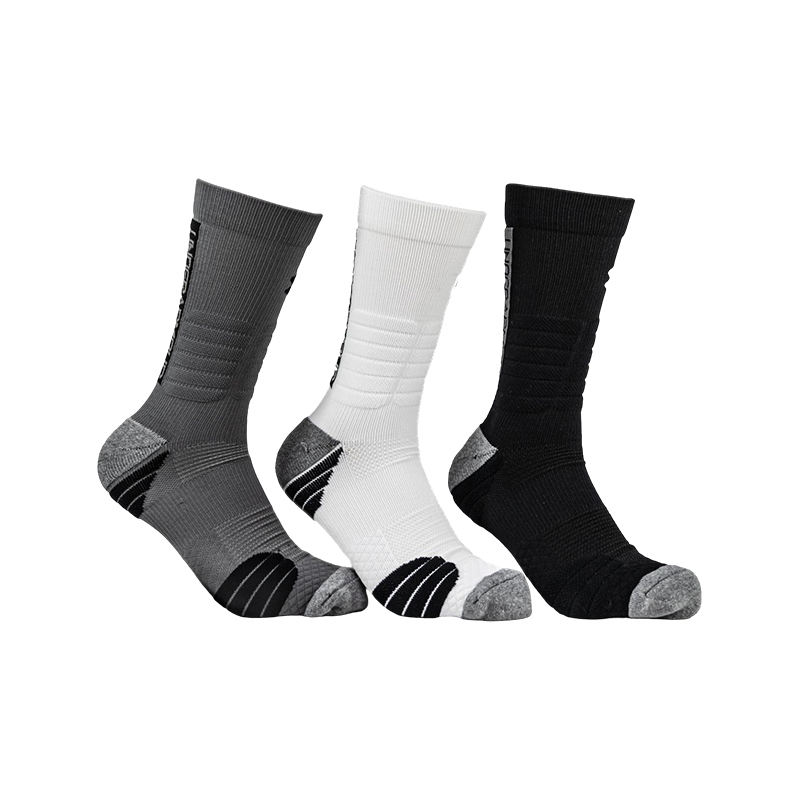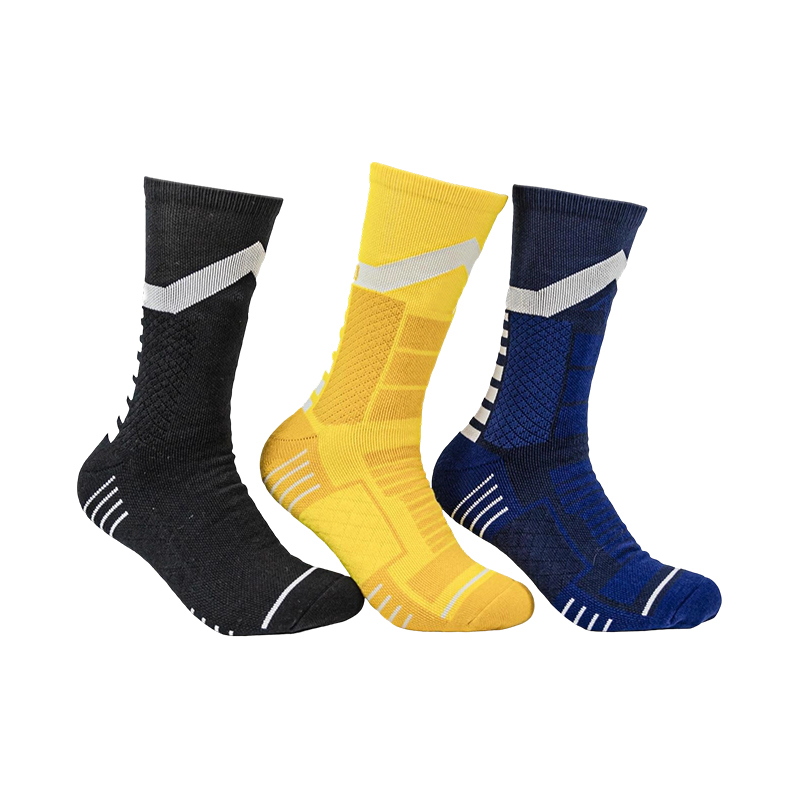
Oct 08, 2026
Content
A 40-minute game puts 500 to 700 ground contacts through each foot, and an elite player covers roughly 2.5 miles doing it. Every one of those landings pushes sweat, friction and lateral shear into the sock before it ever reaches the shoe, which is why basketball socks are specified differently from running, hiking or casual socks.
Haining City Bonroy Trading Co., Ltd., the supplier behind hnbonroy.com, produces basketball socks for importers, team dealers and private label brands from Haining in Zhejiang Province. Four questions decide whether a program ships on schedule and sells through at full price: how much terry, how tall the cuff, which fiber blend, and how many pairs it takes to justify custom tooling. This article answers them in the order they affect a purchase order.
Almost every basketball sock complaint traces back to one of three specification decisions, and all three are visible in the sample room long before they reach a store shelf.
A basketball sock is a cushioned crew or quarter-height sock with a ribbed cuff, a knit-in arch band and targeted terry zones at the heel, forefoot and toe, engineered to absorb impact and manage sweat during stop-start play.
That definition belongs in the tech pack, because it separates basketball socks from compression socks, running socks and business socks that run on the same machinery but carry a completely different structure.
A basketball sock spec sheet needs nine line items: cuff height, cuff rib and elastane content, arch band, heel pocket, terry zones, needle count, toe closure, size range and wash durability. Leave any one of them open to interpretation and the sample round will decide it for you, usually in the wrong direction.
| Specification | Typical basketball value | Failure mode if it is wrong |
| Cuff height | 16 to 20 cm crew, 10 to 13 cm quarter | Cuff creeps below the calf and players pull it up all game |
| Cuff rib and elastane | 1x1 or 2x2 rib with 3 to 5 percent elastane | Cuff loosens after a few washes and slides down |
| Arch band | Knit-in compression band at the instep, 2 to 4 cm wide | Foot slides inside the shoe and hot spots form on the instep |
| Heel pocket | Deep Y-heel gusset with a 40 to 60 degree turn | Heel seam migrates under the arch and rubs against the shoe collar |
| Terry zones | Full terry heel and toe, half or full terry forefoot | Bruising on hard landings and rapid wear at the ball of the foot |
| Needle count | 144 to 176 needles, 168 to 176 for performance lines | Coarse surface, blurred knit-in logos, loose gauge |
| Toe closure | Flat hand-linked seam or fine overlock | A ridge across the toes causes blisters on long sessions |
| Size range | Four to five sizes matched to foot length from 22 to 30 cm | Half-size mismatch returns and poor sell-through on the middle sizes |
| Wash durability | No more than 5 percent shrinkage after 30 home launderings | The sock loses its fit inside a single season |
Needle count is the quiet variable. A 144-needle machine knits a coarser, more open fabric that suits low-cost multipacks, while a 176-needle cylinder gives the denser surface that holds a knit-in logo and a clean mesh panel. Moving a program from 144 to 176 needles adds cost, and it also moves the sock from the value shelf to the performance wall.
The fiber blend decides whether a basketball sock feels dry at the end of a game: polyester and nylon move moisture along the yarn and release it quickly, while cotton and wool absorb it and hold it against the skin.
Those figures explain a design habit that looks odd on paper. High-performing basketball socks often put polyester and nylon in the sole and heel, where sweat pools and abrasion is worst, while keeping combed cotton in the leg for softness. Cotton is not banned from the category, it is simply moved away from the zone that has to stay dry under load.
A 70 percent polyester, 25 percent nylon and 5 percent elastane sole with a cotton-blend leg is the structure most performance basketball programs settle on.
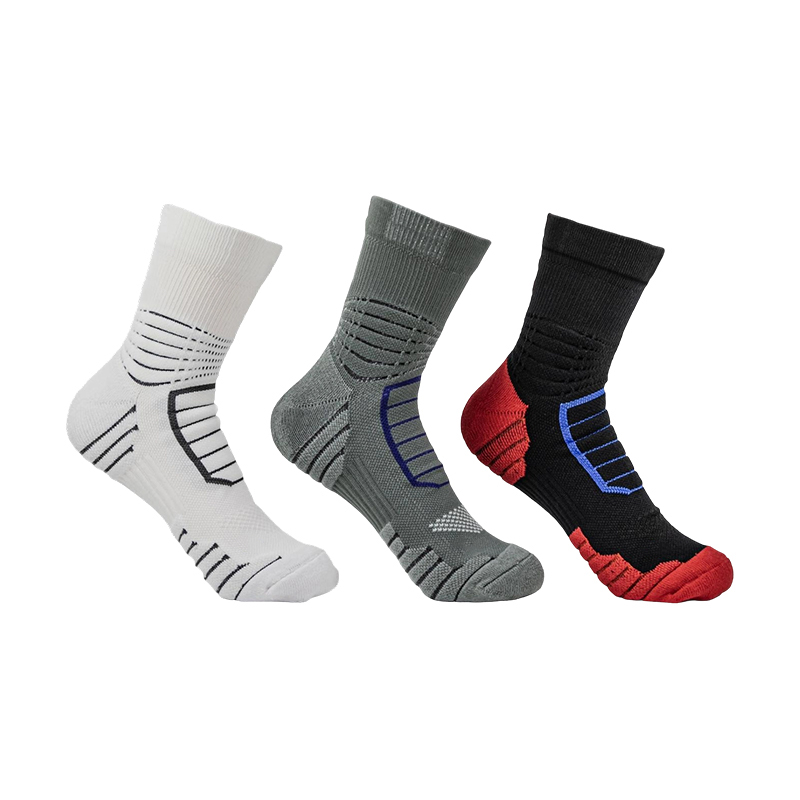 Custom ODM/OEM Men's Basketball Socks B2001Performance court sock with selective terry cushioning, arch support, and cotton-blend moisture management for basketball and volleyball.View Product →
Buyers who order against a fixed blend ratio rather than a fixed price get a second benefit: repeat orders match the first shipment, so a reorder in eighteen months still feels identical to the pair that built the program.
Crew height is the safer default for team and league business because it protects the shin from ankle contact and gives the widest canvas for knit-in branding, while quarter height wins in warm gyms and among players who tape their ankles.
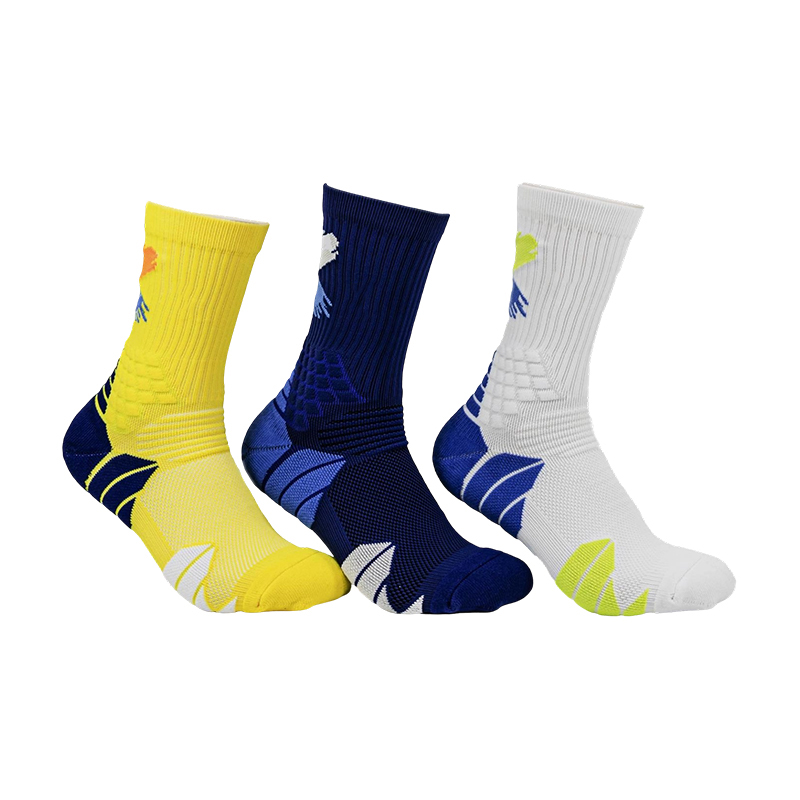 Custom Crew Basketball Socks B1003 for TeamsCrew-length basketball sock with selective terry cushioning, arch compression, and customizable Black, Yellow, or White colorways for court sports.View Product →
A practical compromise that many private label programs run: one crew silhouette in three colorways for team sales, plus a quarter silhouette in two tonal colorways for the retail gym crowd. Both silhouettes share the same terry map, so the sampling cost stays in one place.
A custom basketball sock order moves through five approval gates: tech pack review, proto sample, fit and wash trial, size set with color approval, then bulk production and pre-shipment inspection. Skipping any gate shifts the risk to the bulk order, which is the most expensive place to fix a problem.
Cuff height, terry map, gauge, size range, color references and logo placement are confirmed in writing before a single needle moves.
The first pair is knitted on production machinery, not a hand frame, so the cuff tension and terry density reflect what bulk will actually deliver.
Wear testing with the target athlete profile runs alongside three home wash cycles to check shrinkage and cuff recovery. The sequence used for team orders is documented in this sports team socks guide.
Every size in the range is knitted and measured against the foot-length chart, and each colorway is approved under the same light source the buyer uses.
Knitting, toe linking, boarding and packing run to the approved sample, followed by an AQL inspection before the cartons are sealed.
The full reference document for this sequence is published in the sports team socks guide that covers materials, durability testing and customization for league and club programs.
Most sock mills in Zhejiang and Jiangsu set minimums of 1,000 to 3,000 pairs per colorway for a custom basketball sock, with 10 to 15 days for proto sampling and 30 to 45 days for bulk production after approval.
Four things move the unit price more than the fiber blend. Needle count decides how fine the fabric can be knitted. Terry coverage decides yarn consumption per pair. A knit-in logo adds machine downtime on every size and colorway. Finally, size and color spread decides how many setups the factory has to run, and setup time is what a buyer is really paying for at low volumes.
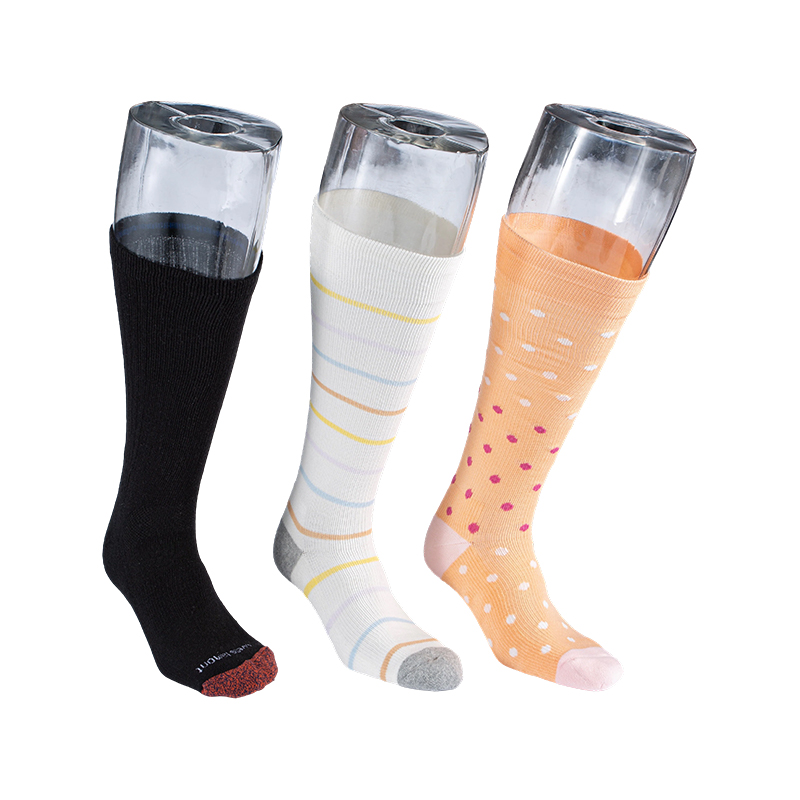 Compression Kneehi Socks CP0009 for Recovery and TravelOver-the-calf graduated compression sock with cotton-rich blend, 144N half-cushion footbed, and size 10-13 fit for recovery or travel.View Product →
Many team programs now pair the playing sock with a compression knee-high for travel and post-game recovery, which keeps the order on one purchase document and one shipment schedule.
A blend of roughly 70 percent polyester, 25 percent nylon and 5 percent elastane in the sole and heel, with combed cotton or a cotton blend in the leg. Polyester and nylon dry fast and resist abrasion where the foot loads hardest, while cotton keeps the leg soft against the shin.
Full terry at the heel and toe with half or full terry under the forefoot. That placement absorbs landing force without making the sock so bulky that the shoe fits tight across the midfoot.
1,000 to 3,000 pairs per colorway for custom knitting, with lower minimums possible when a buyer accepts an existing yarn and color from the mill's stock range instead of a new lab dip.
Approve a production-machine proto sample, then test cuff recovery after three washes, measure every size against the foot-length chart, and confirm terry density and toe seam flatness by hand before releasing the bulk order.



 English
 中文简体
 Español