Oct 01, 2026
Content
Seamless compression socks are the fastest-growing sub-segment in the compression hosiery category, and they have changed how wholesale buyers write spec sheets. Market research from 2024 puts the global compression sock market at roughly $2.8 billion, with seamless circular construction taking an increasing share because it removes the toe seam that causes most comfort complaints. For a sourcing manager, the shift to seamless matters on three fronts: the specification sheet, the unit price, and the QC checklist. This guide breaks down those three fronts with the technical details you need to compare supplier quotes confidently.
Here is what you will find: where seamless socks physically differ, how compression levels are measured and priced, which sizing code returns the lowest failure rate, and the specific QC tests you should run before placing a container order.
Seamless construction removes the physical seam ridge across the toe and shin, which directly reduces chafing and gives a more uniform compression gradient from ankle to calf. For a wholesale buyer, the first clarification is what seamless actually covers in a production setting. It is not just a toe-heel difference. The whole sock is knitted differently.
On a seamless circular knitting machine, the sock is knitted on a small-diameter needle cylinder with multiple yarn feeders laying different yarns into the same loop structure. This lets a mill change the stitch density for the arch, ankle, and calf zones without rethreading the machine. The toe is then closed with a low-profile ROSO process or an infrared fusing step instead of a bulky lockstitch. The result is a sock with fewer contact points against the skin, which is why seamless products show up as lower-chafe compression socks in customer reviews.
From a sourcing standpoint, the machine-side difference also affects tolerance. Because seamless machines hold tension more precisely, the measured mmHg at the ankle tends to stay within a tighter band across a production run. That is a real advantage when your customer is a retailer testing every pair.
Pressure range is the only measurable compression specification. Light or firm on a product sheet is not enough to compare two supplier quotes. Compression socks are classified by mmHg at the ankle, and every level has a different yarn structure and a different unit cost.
The four standard categories used in wholesale sourcing are mild (8-15 mmHg), moderate (15-20 mmHg), firm (20-30 mmHg), and extra firm (30-40 mmHg). The yarn spec changes because elastane content and denier need to hold higher pressure without losing recovery. A 15-20 mmHg sock can run 78 percent nylon, 16 percent cotton, and 6 percent elastane. At 20-30 mmHg, mills usually switch to a higher polyamide share for durability and a tighter elastane denier to keep the gradient from sagging.
| Compression Level | Pressure Range | Typical Use | Yarn Specification |
| Mild | 8-15 mmHg | Light travel, short shifts | 85% Nylon / 15% Elastane |
| Moderate | 15-20 mmHg | Nursing, retail, long flights | 78% Nylon / 16% Cotton / 6% Elastane |
| Firm | 20-30 mmHg | Athletic recovery, marathon | 72% Nylon / 22% Polyamide / 6% Elastane |
| Extra Firm | 30-40 mmHg | Medical, post-surgical | 65% Nylon / 30% Polyamide / 5% Elastane |
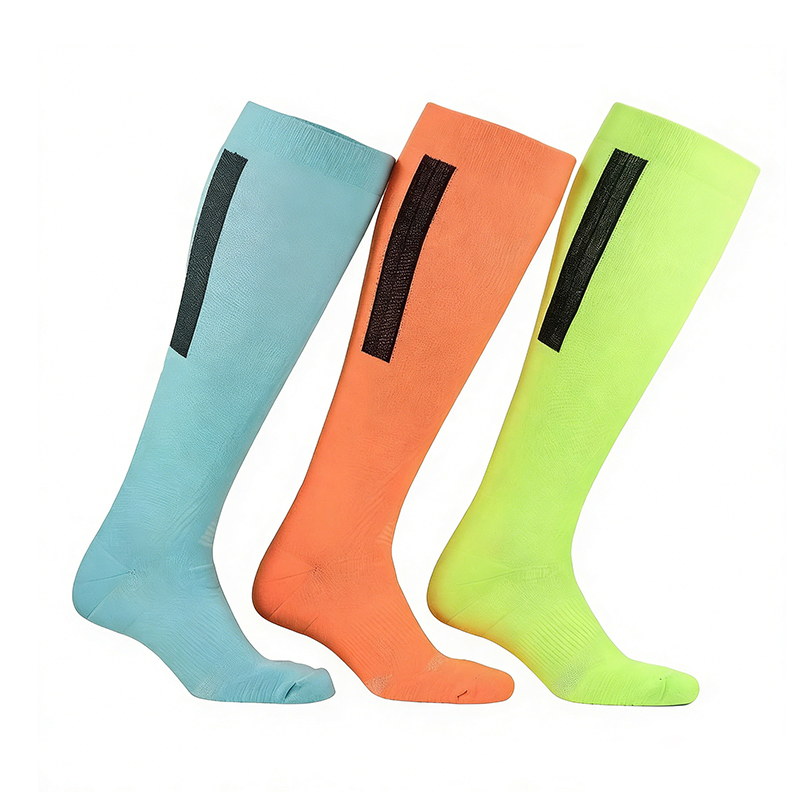 Graduated Compression Socks for Circulation and RecoveryThese 200-needle compression socks use a 97% polyamide and 3% elastane blend to provide firm graduated pressure. Ideal for long flights, standing work, and post-exercise recovery.View Product →
Share of wholesale inquiries by compression level
Seamless compression socks are speced by calf circumference and shoe size, not by S/M/L alone, because seamless knit has less stretch margin than a seamed product. The sizing scale runs from small (8-10 inch calf, shoe 34-38) to extra large (14-16 inch calf, shoe 47 and up).
A 1 cm deviation at the calf can shift the actual mmHg by 2-3, so ordering by shoe size alone creates a high return rate. This is especially true for knee-high styles, where the top band sits at the largest diameter of the calf. Add the length of the sock to the spec sheet. Knee-high releases the full ankle-to-calf gradient, while crew or ankle lengths only give a mild compression effect.
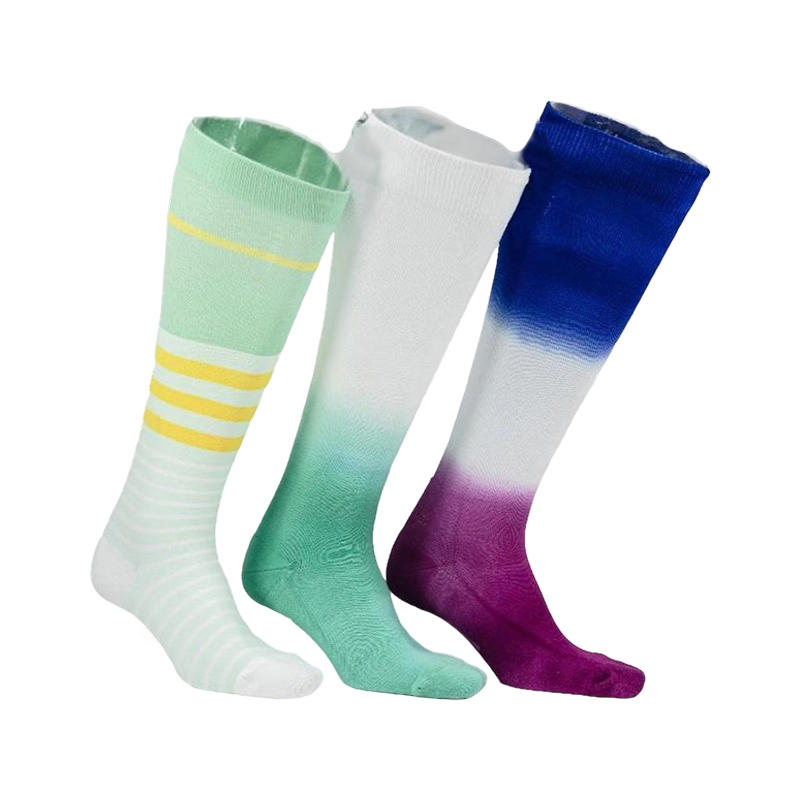
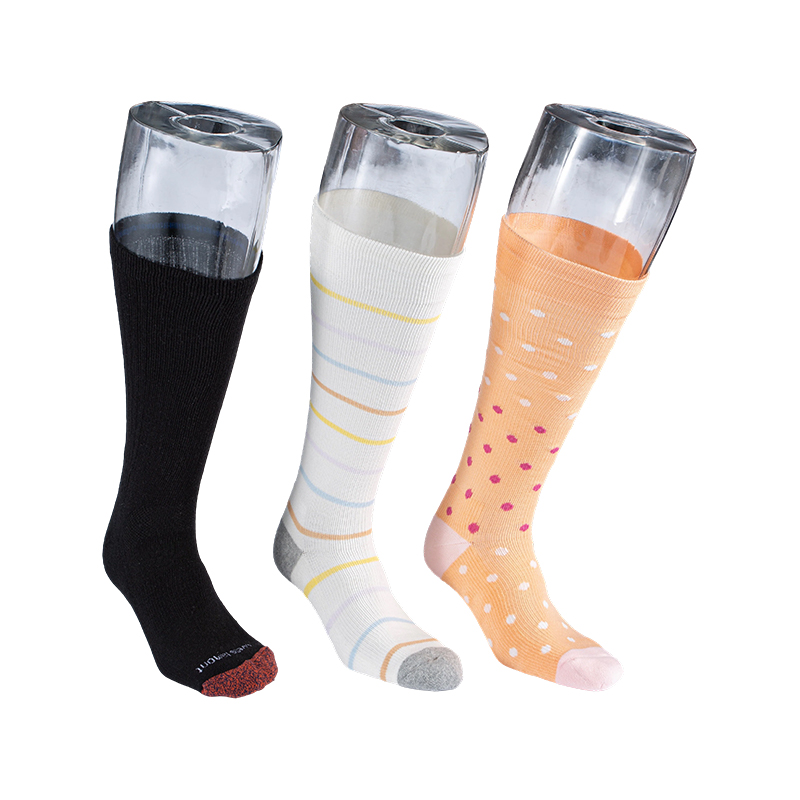 Cotton-Rich Knee-High Compression Socks for Moderate SupportAn 85% cotton, 18% nylon, and 2% spandex knee-high sock with 144-needle half-cushion construction. Offers gradual compression for leg fatigue relief and comfort during extended sitting or standing.View Product →
Three QC failures cause most complaints on seamless compression socks: inconsistent pressure across the batch, open or loose toe closures, and shrinkage after laundering. Run a pressure test on at least three pairs from every production batch. A medical-grade compression tester measures at the ankle and the calf; reject any pair that falls outside +/-3 mmHg of the spec.
Check the ROSO toe closure with a fingertip pass across the seam. Any loose loop or snag means the machine tension drifted during that run. Then run a five-cycle wash test and measure stretch recovery. A sock that loses more than 5 percent of its original recovery will produce returns within the first month of wear.
These checks mirror what a factory should already do. For a deeper look at how a high-quality knitted product is built, read the breakdown of the complete sock manufacturing process.
Machine capacity, elastane sourcing, and QC documentation are the three decision factors that separate a reliable seamless compression sock supplier from a generic knit factory. Ask how many seamless machines are running compression products specifically. Tension control is the differentiator, and machine count tells you whether the supplier can hold a consistent gradient across a full order.
Then check the elastane source. Branded elastane at a specific denier gives a much tighter stretch-recovery curve than commodity spandex. Finally, ask for QC data attached to the batch: compression test data per lot, dye lot tracking, and wash test results. Haining City Bonroy Trading Co., Ltd. positions its manufacturing and trade operations around knit comfort, and this is the kind of documentation a serious buyer should expect from any partner.
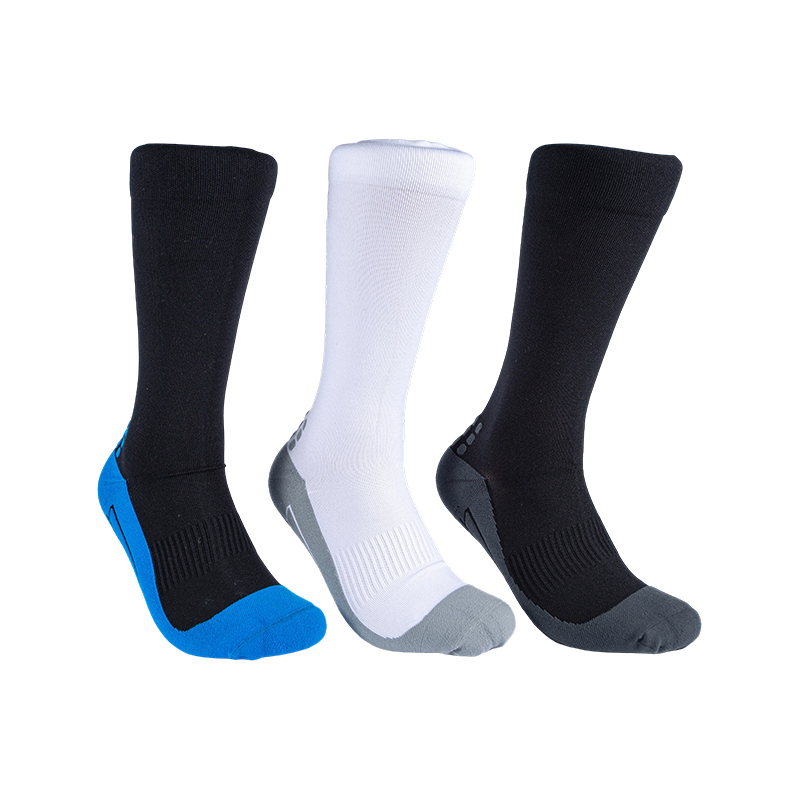 Durable Nylon Compression Socks with Cushioned FootbedFeaturing 98% nylon and 2% spandex in a 144-gauge knit with select cushioning. These socks provide abrasion resistance and targeted impact absorption for sports recovery, medical use, and travel.View Product →
Standard top band pressure for a knee-high seamless compression sock. Anything wider or narrower changes the contact area and the comfort compliance.
Seamless socks are knitted on a circular machine as a continuous tube and then toe-closed with a low-profile process, so there is no raised ridge. Flat-knit socks use a standard seam sewn on a separate machine, leaving a seam that can rub. For compression garments, the seamless structure distributes pressure more evenly across the leg.
Most general retail lines sell 15-20 mmHg. It covers nurses, flights, and daily standing without requiring medical certification. For sport and recovery oriented ranges, 20-30 mmHg is the best-selling size.
The length controls how much of the leg receives the gradient. Knee-high delivers the full ankle-to-calf compression, while crew length only gives a mild effect. If the spec requires 20 mmHg at the ankle, order knee-high.
Yes. Seamless machines run slower and have a higher unit cost than standard flat-knit machines. But the return rate is lower because the fit is more consistent, which offsets the higher unit cost for most wholesale orders.



 English
 中文简体
 Español