

 English
 中文简体
中文简体 Español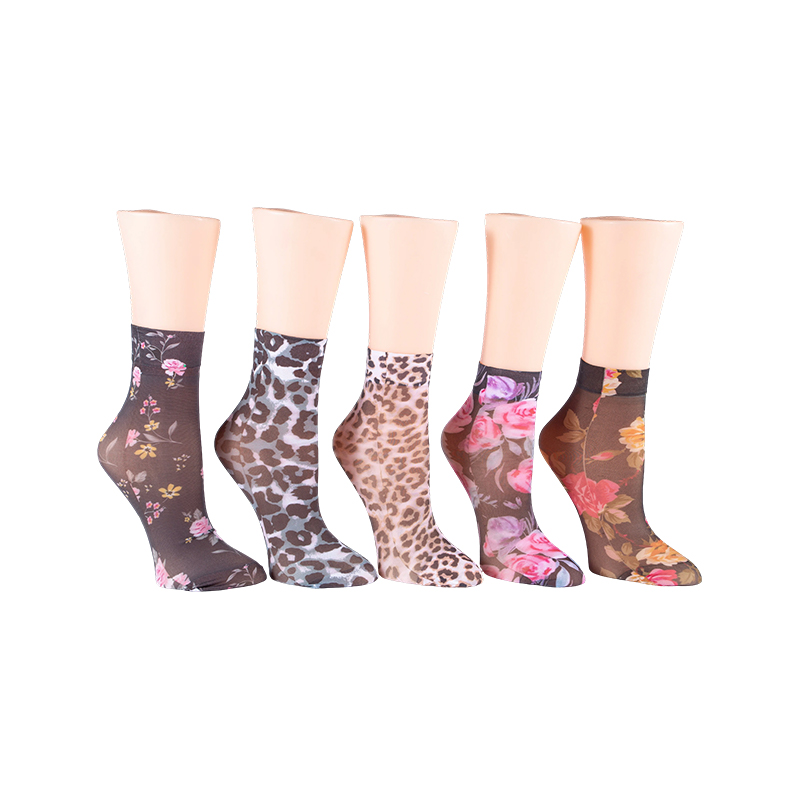
Product Information
Ladies Print Socks employ 200N fine-gauge knitting construction with a cylinder density of 200 needles per inch. Fabric comprises 97% nylon and 3% spandex—nylon provides abrasion resistance and elastic recovery, while spandex enhances lateral stretch capacity. Size 9-11 corresponds to foot length 23-25cm. Print patterns apply via digital heat transfer or rotary screen printing with resolution above 300dpi, achieving precise reproduction of complex graphics and gradients. 200N high-gauge knitting creates a smooth fabric substrate, reducing dot gain in printed areas and maintaining pattern edge sharpness.
Core Advantages
Pattern Fidelity: 200N gauge produces surface smoothness superior to standard 144N products, reducing print dot gain by 15-20% on dense substrate with diminished edge jagging. Digital heat transfer supports CMYK four-color overlay with color gamut coverage above 90%.
Color Durability: Nylon fiber glass transition temperature 40-50°C; heat transfer printing at 180-200°C drives disperse dyes into fiber amorphous regions, forming molecular-level bonds. Wash fastness achieves grade 4 (GB/T 3921-2008), with color deviation ΔE≤3 after 20 wash cycles.
Anatomical Fit: 3% spandex content provides 25-30% lateral stretch, accommodating instep height variations. Nylon fiber breaking elongation 25-35% maintains cuff-to-foot containment relationship through repeated donning and doffing.
Fabric Lightness: 200N fine gauge with nylon filament yields fabric thickness 0.4-0.6mm and mass 30-40g/m², over 50% lighter than equivalent cotton socks, suitable for footwear with limited interior volume.
Technical Specifications
Gauge: 200N single cylinder circular machine
Fiber Composition: 97% Nylon / 3% Spandex
Size Range: 9-11 (foot length 23-25cm)
Fabric Thickness: 0.4-0.6mm
Fabric Mass: 30-40g/m²
Print Process: Digital heat transfer or rotary screen, 300dpi resolution
Color Capacity: 12+ colors
Pattern Placement: Instep primary area, sole留白 or simplified treatment
Cuff Structure: Single-layer rib, 2.5cm width
Toe Closure: Linked toe, seam thickness ≤0.5mm
Application Scenarios
Daily Commute: Print patterns create visual contrast with solid-color footwear; 200N thin structure adapts to low-profile styles, including loafers and oxfords, reducing interior crowding.
Thematic Coordination: High-resolution printing supports brand collaboration, art IP, or seasonal limited patterns, enabling color coordination with tops or accessories.
Light Exercise: Nylon fiber wet strength 85-90% of the dry state maintains structural stability in perspiration conditions. Thin structure accelerates moisture evaporation for yoga, Pilates, and low-intensity activities.
Travel Packing: Fabric compresses to 30% original volume with a 2-3 hour drying time, supporting rapid turnover during travel.
Care & Maintenance
Wash at temperatures not exceeding 30°C, using neutral detergent pH 6-8. Nylon fiber hydrolyzes under acidic or alkaline conditions with strength loss. Avoid chlorine bleach—available chlorine oxidizes amide bonds in nylon molecular chains.
Turn inside out to reduce mechanical friction between the print surface and the washing machine interior. Dark prints may exhibit slight color bleeding in initial washes; launder separately to prevent staining other garments.
Avoid direct sunlight when drying—UV initiates nylon photo-oxidation, fiber embrittlement, and accelerated print fading. Clip at cuff when hang-drying, avoiding direct clamp contact with printed areas that causes indentation.
Iron at temperatures not exceeding 120°C; steam ironing restores smoothness. Avoid direct iron contact with the print surface—high temperatures cause disperse dye migration. Store folded flat long-term with paper between print faces to prevent adhesion.
Slight stiffness at print edges is a normal physical state after dye fixation, softening after several wears. Avoid prolonged friction with rough shoe linings to reduce mechanical print layer exfoliation.
Frequently Asked Questions
How does a 200N gauge specifically affect printing?
Gauge determines fabric loop density and surface smoothness. 200N's tighter loop arrangement versus 144N reduces surface irregularity, diminishing print dot gain and improving pattern detail reproduction. High gauge simultaneously reduces fabric thickness, improving shoe fit.
Does 97% nylon content affect breathability?
Nylon fiber inherently exhibits a wicking effect, conducting liquid perspiration along fiber surfaces. 200N knit structure supports air convection with permeability approximately 400-500mm/s, higher than equivalent-density polyester. 3% spandex primarily provides elasticity with minimal breathability impact.
Does printing block fabric pores?
Heat transfer printing drives dye molecules into fiber surfaces only, without forming continuous covering films; fabric pores remain open. Rotary screen printing with high-concentration paste may create slight local coverage, but a 200N dense structure inherently has small pores—impact is negligible.
How to address pattern cracking or peeling?
Nylon fiber's strong elastic recovery prevents permanent deformation that causes print cracking under normal wear. Localized peeling usually results from prolonged friction with rough shoe interiors. Inspect the shoe lining's smoothness and avoid contact with hook-and-loop fasteners. Print layer damage does not affect sock's structural function.
Component
97% Polyamide
3% Elastane