


 English
 中文简体
中文简体 Español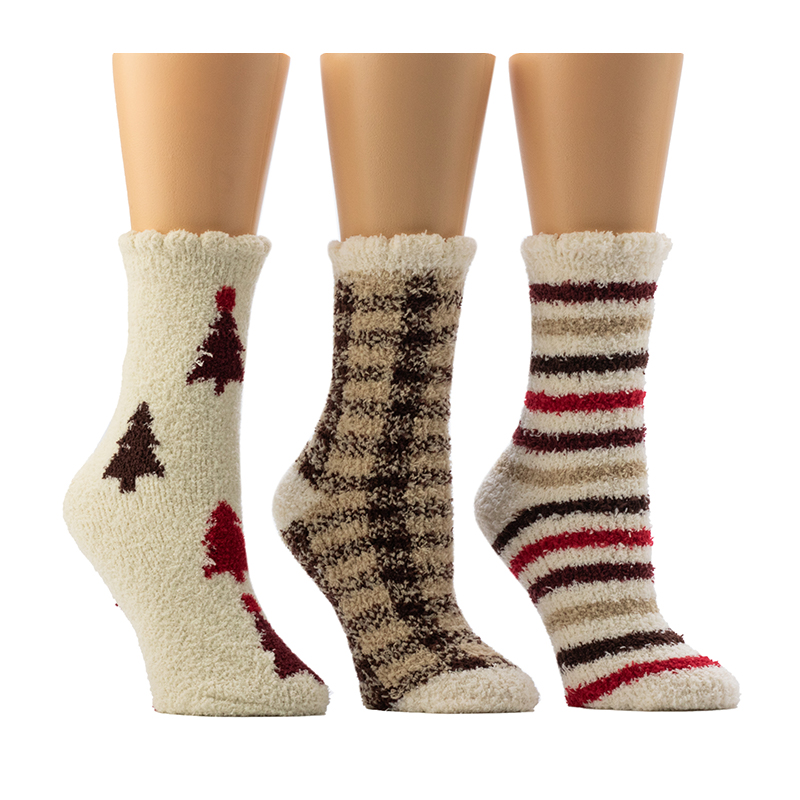
Product Information
Ladies Cosy Socks are built around a two-zone knitting construction that assigns distinct structural roles to the leg and foot sections of a single sock. The leg is knitted at 84 needles, producing a compact, smooth-surfaced structure. The foot is knitted at 56 needles, where the wider stitch spacing allows pile fibers to extend fully, forming a dense, cushioned contact layer at the sole and heel. This zonal approach places pile thickness precisely where direct foot contact occurs, while the leg section retains a slim, unobtrusive profile suited to wearing inside boots or with fitted footwear.
The fiber composition is 99% polyester and 1% spandex, in size 9-11. Polyester forms the pile structure, maintaining loft and color stability across repeated wash cycles. Spandex is concentrated at the cuff, providing consistent rebound and preventing cuff drop during extended wear. The product is suited to autumn and winter boot wear, indoor casual use, and seasonal gifting, occupying a clearly defined position within the women's cosy sock category.
Core Advantages
Clearly Defined Functional Zones: The 84-needle leg and 56-needle foot create a density gradient within a single sock — the leg handles appearance, the foot handles warmth and cushioning — avoiding the bulk of full-fleece constructions inside fitted footwear
Durable Polyester Pile: Polyester pile maintains loft more consistently across repeated machine washing compared to acrylic, with a slower decline in surface fullness over the product's use cycle
Measured Spandex Application: At 1%, spandex is applied where it performs its primary function — cuff elasticity — without contributing tightness or rigidity to the sock body
Single-Size Broad Coverage: US size 9-11 corresponds to approximately EU 37–42, covering the mainstream adult women's foot range within a single SKU and simplifying inventory management for retailers
Multi-Channel Commercial Compatibility: Standardized construction and composition support placement across chain retail, e-commerce platforms, and gift set formats without product modification
Product Specifications
Knitting Gauge: Leg section 84 needles (SOCK 1-84N); foot section 56 needles (SOCK 2-56N)
Fiber Composition: 99% Polyester, 1% Spandex
Size: 9-11 (foot length approximately 23–27cm; EU 37–42 approximately)
Pile Zone: Foot section — sole, arch, and heel; leg section features fine plain or jacquard knit structure
Leg Section: 84-needle compact knit; even surface finish suitable for visible exposure at boot cuff or above low-top shoes
Foot Section: 56-needle open-stitch construction allows full pile extension; cushioned, soft sole contact surface
Cuff Elasticity: Spandex elastic band with stable rebound; resistant to downward displacement during wear
Dyeing Performance: Polyester accepts consistent dye saturation; two-tone leg/foot color-block construction is technically supported
Care: Machine wash; maximum 40°C; laundry bag recommended; do not tumble dry on high heat
Application Areas
Boot Footwear: The pile foot zone delivers sole warmth and cushioning while the slim leg section avoids adding volume inside snow boots, Chelsea boots, or work boots during autumn and winter
Indoor Casual Wear: Pile concentrated at the sole provides underfoot comfort for barefoot indoor movement or wearing with lightweight slippers over extended periods
Casual Lifestyle Styling: The neat 84-needle leg section works visibly above sneaker collars or with cuffed trousers in casual outdoor settings
Seasonal Gift Packaging: The two-zone construction provides a tangible product story for gift box presentations; suited to Christmas sock sets, Thanksgiving gift bundles, and winter gifting occasions
Retail Buyer Procurement: Standardized size coverage and composition facilitate straightforward seasonal sock category replenishment across department stores, supermarkets, and online platforms
Brand OEM & Custom Development: Defined construction parameters provide a stable base for custom colorways, jacquard leg patterns, woven brand labels, or composition adjustments
FAQ & Technical Considerations
Q1: Does the transition between the 84-needle leg and 56-needle foot create any discomfort at the ankle?
The needle count shift is executed through the knitting program at a set course point, with the join positioned on the sock interior. No external seam ridge is produced under normal construction. Setting an appropriate number of transition courses allows the thickness change to progress gradually, so the ankle area does not register an abrupt shift in feel during wear. Wear testing of the transition zone is recommended at the pre-production sample stage.
Q2: How does polyester half-fleece compare to cotton fleece socks for the end consumer?
Polyester pile holds its shape and color saturation more consistently than cotton fleece across repeated washing, and is less prone to pilling over time. Cotton fleece offers the moisture absorption and natural breathability characteristics of cotton fiber, which is relevant for consumers with sensitive skin or higher perspiration requirements. The two constructions serve different consumer priorities — polyester half-fleece is better suited to consumers who prioritize appearance, longevity, and easy-care maintenance.
Q3: Will the pile in the 56-needle foot section flatten or thin out with regular use?
Lower-needle-count construction gives pile fibers more room to extend, supporting a fuller initial loft. Gradual pile compression with wear frequency is a normal characteristic of pile textile products. To slow compression, allowing the sock to recover its natural loft after each wear is beneficial, as is washing inside-out in a laundry bag to minimize pile abrasion against other garments.
Q4: Can jacquard patterns be added to the 84-needle leg section for custom orders?
The 84-needle gauge supports jacquard knitting, making geometric patterns, text, brand logos, and color-block designs technically feasible in the leg zone. Jacquard designs require artwork or design files to be submitted at the sample development stage for factory assessment of pattern resolution within the needle count constraints. Pattern fidelity is confirmed before formal sample production proceeds.
Q5: What compliance requirements apply to product labelling for the European market export?
Textile products exported to European markets must comply with EU Textile Labelling Regulation No 1007/2011, requiring labels to state fiber composition with precise percentages, care symbols per ISO 3758, country of origin, and responsible party information. Fiber names must use the standardized terminology defined in the regulation — "Polyester" and "Elastane" respectively — and commercial brand names may not substitute for regulated fiber names. Label content review is recommended at the sample stage to address compliance requirements before bulk production.
Component
99%Polyester
1%Elastane